AI Agents in Slack: The Accountability Gap Nobody's Solving
AgentHub has pushed its Data Analysis Agent directly into Slack, pitching enterprise teams on instant, plain-English answers from their data without ever leaving the chat window. Ask a question, get a chart or summary back in the same thread — no dashboards, no analyst to brief. The demo is genuinely slick.
It's also a useful case study in the accountability gap quietly widening across every AI service platform right now.
The Workflow Is Not the Outcome
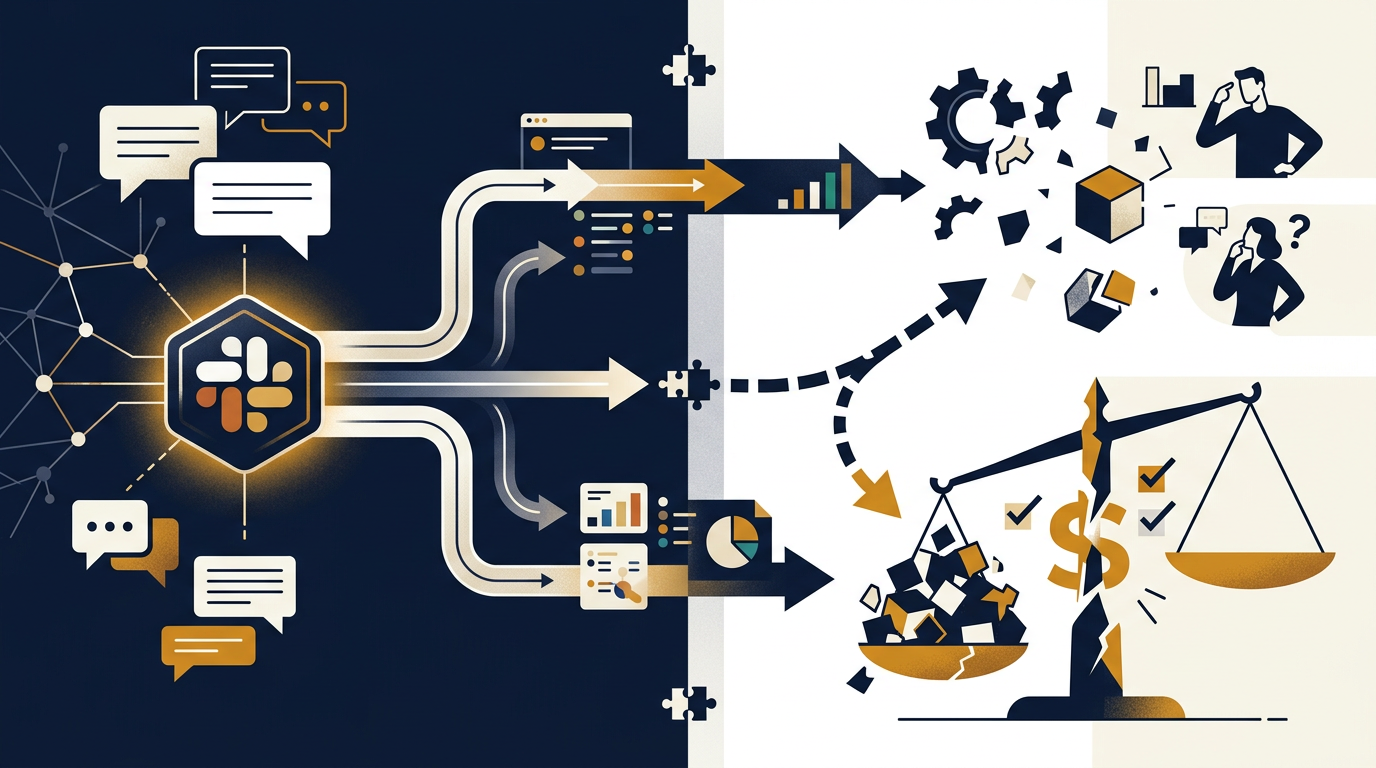
Here's the structural problem with selling an AI agent as a Slack integration: the workflow becomes the product, not the result it delivers. When an answer lands in your thread, you get a response. What you don't automatically get is any way to know whether that response was correct — whether the agent queried the right data source, interpreted your question as intended, or would have returned something different if you'd phrased it slightly differently.
For low-stakes queries, that's probably fine. For the kind of data analysis that actually informs a business decision, the accountability chain is murky. Who owns the error if the output was wrong? The agent? The integration? The buyer who embedded it into their workflow?
This isn't an AgentHub-specific failure — it's endemic to what you might call the feature-bolt-on model across the AI agent marketplace category. When an agent is packaged as a productivity add-on inside an existing tool, the implicit message is: the integration is the value. But integration and outcome are two different things, and conflating them is an expensive mistake for any buyer procuring AI services at scale.
AI Isn't Eliminating Work — It's Repricing Judgment
This tension is playing out against a broader economic backdrop. Platformer this week published an economist's case against the AI jobs apocalypse, arguing that AI is restructuring how knowledge work gets done rather than erasing it wholesale. The framing matters: if AI isn't eliminating the need for skilled judgment — just shifting where in the workflow that judgment gets applied — then the smart buyer question changes.
It's no longer "can I automate this?" It's "how do I know the automated output is trustworthy?" That's as much a procurement question as a technology question. And it's one the current generation of AI service platforms, including the incumbent players on Fiverr and Upwork, haven't fully answered.
Both platforms deserve credit for moving quickly to integrate AI tooling. But their underlying commercial model remains upfront-payment-for-deliverable: you pay, you receive a file or a report or a piece of code, and then you find out whether it was any good. Accountability sits entirely after the transaction. If the result falls short, dispute resolution is your only recourse — a process that consumes time, generates friction, and still doesn't guarantee you get what you actually needed.
Who Controls Verification Controls the Stack
Ben Thompson's Power Shifts piece is worth reading alongside the AgentHub story. His core argument — that AI-era power is accruing to whoever controls the layer where value is verified, not just where it's generated — maps directly onto the marketplace question. If the agent produces the analysis but a human still has to audit it, the tool's value is bounded by the quality of that verification step. Whoever makes verification legible and reliable will own the most defensible position in the stack.
Right now, most platforms are competing on generation quality: more agents, more integrations, more categories covered. The real competitive opening is in verification infrastructure — the structural guarantee that what gets delivered is what was actually needed.
What Outcome-Based Procurement Looks Like in Practice
Compare the two dominant models competing for buyer attention right now.
With AgentHub's Slack-native Data Agent, the buyer commits to a workflow before seeing results. You deploy the integration, configure the agent, embed it in your team's daily process — and the deliverable is the integration itself. Whether the outputs it generates are accurate or actionable is a separate question the product doesn't structurally answer. The integration is sold; what the integration produces is left for you to audit.
With Fiverr and Upwork's upfront-payment model, the sequence is pay first, then assess quality. The platform's incentive is to close the transaction; yours is to get a usable outcome. Those aren't the same thing, and the payment structure reflects the platform's priority, not yours.
An outcome-based model inverts that risk allocation by design. Post a task, receive functional prototype output, then decide whether it meets the bar. Payment follows verified results — not the promise of them. That's not a feature or a policy detail. It's the entire commercial logic, and it's the correct structural response to a market where AI-generated work is proliferating faster than buyers' ability to audit it.
The Takeaway
If your team is evaluating AI service platforms right now, the right first question isn't which one has the most agents or the deepest integrations. It's which one requires the vendor to be right before they get paid.
The accountability gap AgentHub's Slack launch exposes isn't going to close through better UX or more capable models. It closes when the payment model and the outcome are structurally linked — and most platforms aren't there yet. Post a task on AITasker and see what outcome-based accountability looks like from the buyer's side.