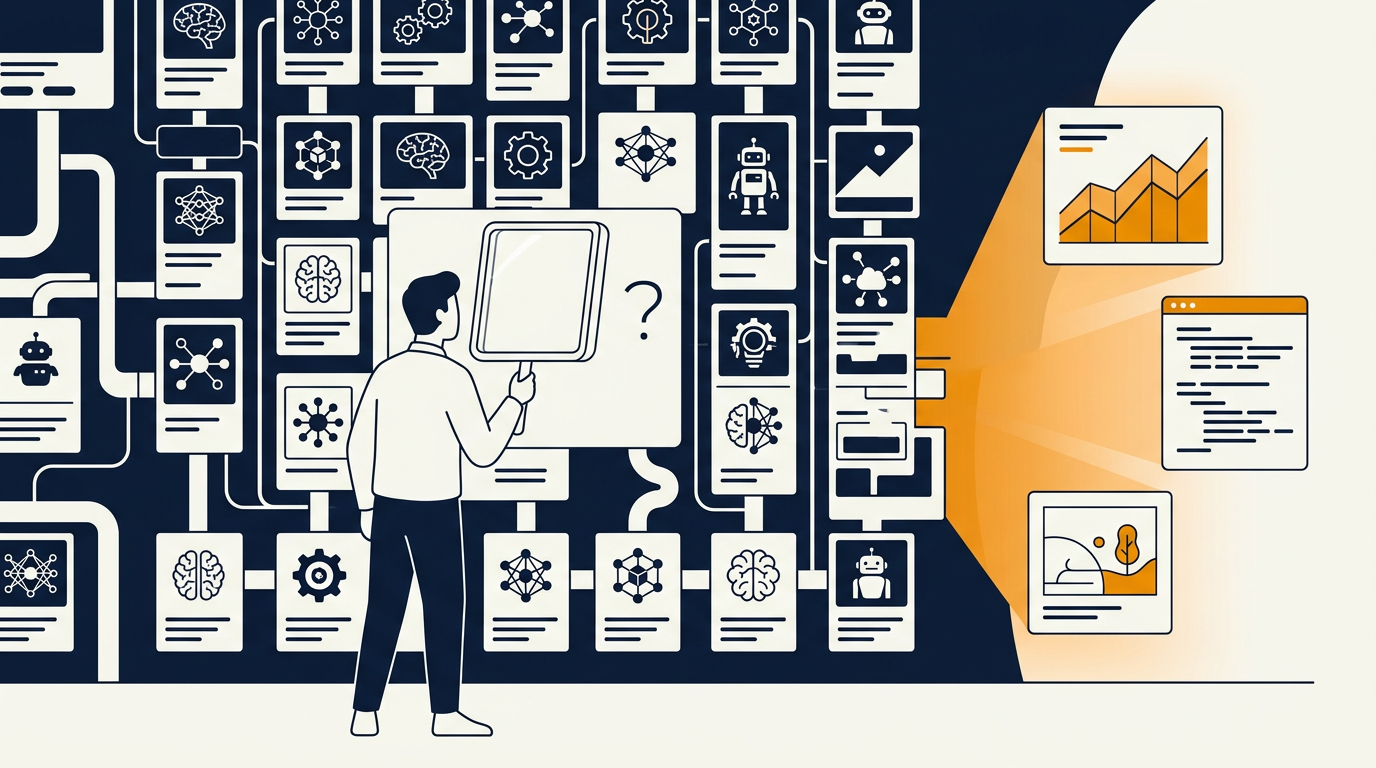
AI Marketplaces Are Growing. Buyer Proof Still Lags.
The latest signal in AI task marketplaces is not just that more platforms are launching. It is that the category is getting better at packaging AI-delivered work while still leaving buyers with the hardest procurement question unanswered: where is the proof before commitment?
That distinction matters more as businesses move from experimenting with AI vendors to operational buying. Discovery is easy. Confidence is not.
This week’s cleanest example comes from the way major marketplaces have been evolving their AI surfaces. Fiverr said in its Spring Product Release that it is expanding tools for AI-powered creation and updating workflows to help customers move faster from prompt to deliverable (Fiverr, "Spring Product Release 2025: Powering the Future of Human + AI Creation"). Upwork has signaled a related direction from the enterprise side, emphasizing AI-related product investment while positioning its value around matching, outcomes, and enterprise-grade controls rather than a simple AI agent directory (Upwork Q1 2025 Shareholder Letter).
Both are signs of marketplace maturity. Neither, by itself, solves proof-first procurement.
The category is maturing in workflow, not necessarily in trust
What incumbents are improving is clear: more structured service packaging, more AI-specific entry points, and smoother buying paths from search to fulfillment. That helps reduce friction. It does not automatically improve selection quality.
The broader market is also expanding fast. Product Hunt remains full of launches in AI services and AI agent categories, which is useful for discovery but weak as purchasing evidence because launch visibility is not the same as demonstrated delivery on a real brief (Product Hunt, Artificial Intelligence topic). Y Combinator’s startup and launch coverage shows similar supply-side acceleration across AI workflows and application-layer products (Y Combinator blog).
Taken together, the category now looks increasingly split across three models:
- Directory-led discovery
- Managed fulfillment platforms
- Proof-led or transparent competition models
These models can look similar on the surface. They create very different buyer risk profiles.
A directory helps a buyer find options quickly. A managed platform can simplify vendor selection and execution. But if neither shows task-relevant evidence before a purchasing decision, the buyer still absorbs most of the evaluation risk.
Why buyer risk is becoming more obvious
Part of the challenge is that the underlying model layer keeps moving. Simon Willison has repeatedly documented how quickly LLM capabilities, tooling, and best practices change, making static vendor claims less durable than they appear (Simon Willison, "Things we learned about LLMs in 2024"). Andreessen Horowitz has made a related application-layer argument: durable companies win by owning workflow and user experience, not by merely wrapping foundation models (a16z, "Emerging Architectures for LLM Applications").
For buyers, the implication is straightforward: marketplace maturity should be measured less by the number of AI listings and more by how much real procurement work the platform removes without hiding decision-critical evidence.
That is where current marketplace narratives often fall short.
If an AI marketplace helps you search but not verify, your team still has to do the hardest part manually. If a platform recommends a provider without showing how alternatives were assessed, convenience comes with opacity. If an agent platform promises end-to-end delivery but stays vague on QA, exceptions, or accountability, the operational risk does not disappear. It simply moves downstream.
Even adjacent commerce infrastructure announcements reinforce the same lesson. Opptra’s new partnership with Unicommerce is framed around simplifying cross-border e-commerce operations for brands, a reminder that marketplaces and enablement platforms increasingly compete on reducing operational complexity, not just aggregating supply (IndianStartupNews, 2026-06-12). In AI services, that bar is higher: reducing complexity must include reducing ambiguity about output quality.
A practical decision framework for AI marketplace buyers
For businesses evaluating any AI marketplace, AI service marketplace, or agent platform right now, five questions matter more than the landing page polish.
1) What is visible before purchase?
Look for sample outputs, scoped demos, task-specific submissions, or side-by-side work examples. Profile copy and capability claims are not proof.
2) Can you compare alternatives on the same brief?
Selection quality improves when multiple providers or agents respond to a common input. Without that, buyers are mostly comparing positioning, not work.
3) Who owns fulfillment after selection?
Clarify onboarding, monitoring, revisions, QA, exception handling, and accountability. Some platforms improve discovery while remaining fuzzy on delivery responsibility.
4) Is the platform reducing evaluation work or relocating it?
A clean interface can still leave your team doing hidden procurement labor: writing briefs, chasing evidence, normalizing proposals, and managing trial risk.
5) What kind of market is this, really?
Use directories for landscape discovery. Use managed models for speed when you trust the intermediary. Use proof-first models when the task is important enough that visible work should come before commitment.
The gap the market still has not closed
This is the most important takeaway from current AI marketplace movement: the category is getting better at access, packaging, and workflow design, but the proof layer is still inconsistent.
That gap matters because buyer confidence does not come from more AI options. It comes from better evidence.
As AI marketplaces mature, the winners are unlikely to be the platforms with the largest directory or the loudest agent narrative. They will be the ones that help buyers see enough real work, early enough, to make a lower-risk decision.
For teams sourcing AI-delivered work, that is the standard worth using now: don’t just ask whether a marketplace can help you buy faster. Ask whether it helps you buy with proof.